
What your engagement data is telling you, and how Winningtemp leads the way


Most HR leaders already know engagement matters. What's harder to know is where to focus, and whether the changes you're making are actually shifting the needle.
For our 2026 research report, High Performing Organizations we analyzed data from 876 organizations and more than 236,000 employees to find what separates the top 25%, so called High Performers, from the rest. Not in broad strokes, but category by category, question by question.
What came out of that analysis wasn't a single silver bullet. It was something more useful: five clear implications for how HR leaders can turn data into meaningful action.
Here's what the data says, and how Winningtemp is built to help you act on it.
1. Stop benchmarking against the average
If your organization is already performing reasonably well, the average benchmark is the wrong target. It confirms where you are. It doesn't show you what's possible.
In our dataset, the median HPI (High Performance Index) sits at 7.68 out of 10. More than half of organizations fall into what we call the "Stable" zone — doing fine, but nowhere near the top quartile. When you compare yourself to that average, you're measuring against the status quo.
High-performer benchmarks are more honest. They show you what the top 25% actually achieve, and where your organization has real room to grow.
What does this look like in Winningtemp?
Benchmarks gives you five ways to compare: against peers in your industry or by team function. So whether you're a CHRO looking at the big picture or a manager comparing your sales team to others, you're always measuring against the right reference point, not just a generic average.
Our VP of Sales, Leith Mansoor, walks you through exactly how this works in the video below.
ADD VIDEO
2. Start with the five highest-leverage behaviors
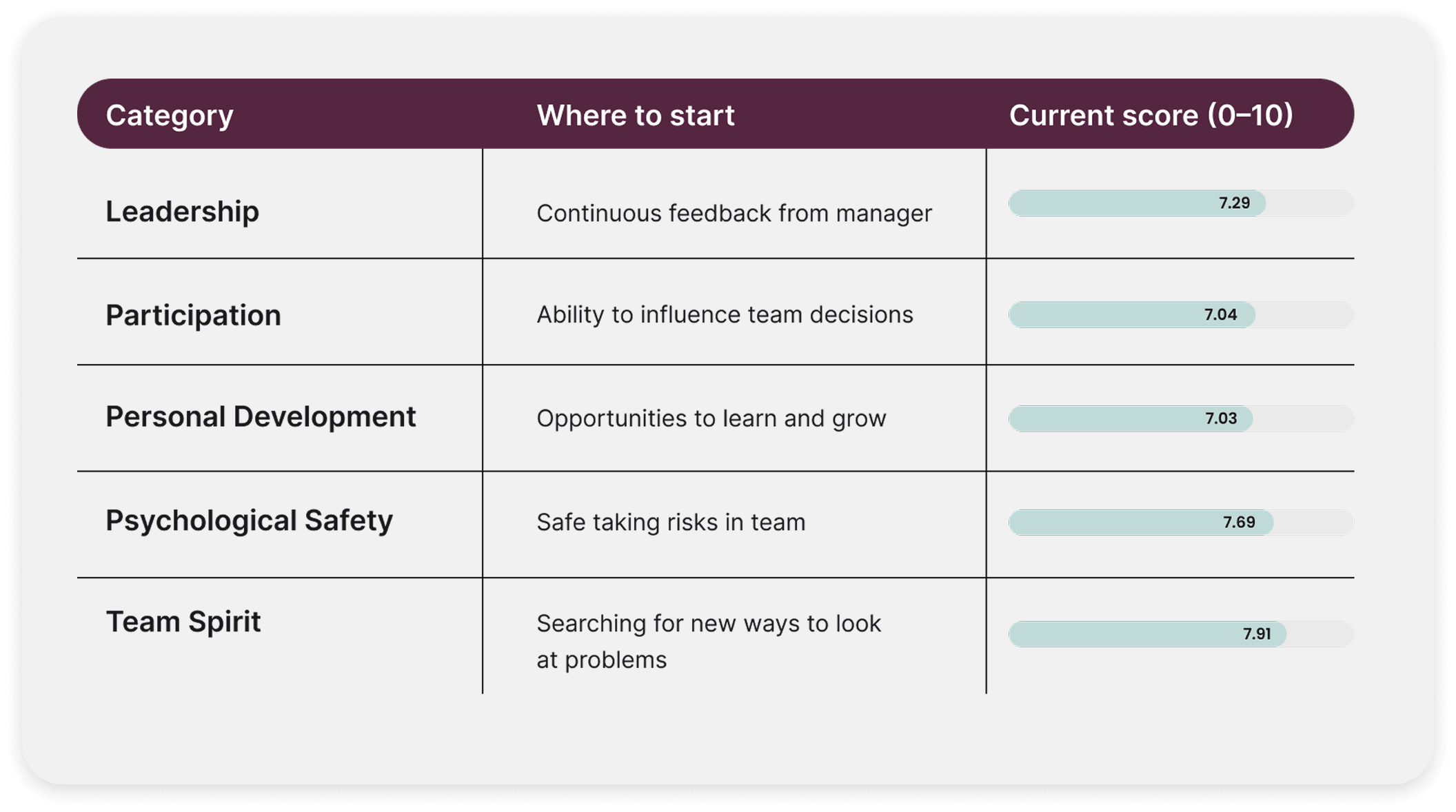
Research identified the five question categories across the HPI framework with the highest return of investment, the intersection of high predictive importance and low current performance. As you can see, three of the five score below 7.5, not abstractions, but specific behaviors managers can change this week.
What does this look like in Winningtemp?
Actionable Insights automatically identifies your organization's strengths, areas for improvement, and risks. Each insight tells you which team, which category, what changed, and when, making it easy to act and start conversations in minutes.
But knowing what changed is only half the picture. Deep Dives gives managers the why: structured depth, real context, and a clear path to action so decisions are grounded in understanding, not just scores.
3. Treat institutional trust as a leadership issue, not an HR program
This finding is one of the more uncomfortable ones in the research: the questions that most clearly separate High Performers from the rest are not about employees' direct managers. They're about whether employees trust senior leadership.
The single most differentiating question across all 40 measured in the study is "I am proud to work for this company." The other top-differentiating questions are about whether senior leadership is competent, fair, and acting with good intentions.
Manager trust is, in fact, broadly consistent across the dataset. Employees generally trust their direct managers. What they don't consistently trust is the institution; the C-suite, its decisions, its motives.
HR can measure this. Closing the gap requires the people at the top. This is not a communication program problem. It's a leadership behavior problem, visible in pay decisions, restructurings, promotions, and how senior leaders show up in difficult moments.
What does this look like in Winningtemp?
The Heatmap makes it possible to see Trust scores broken down by team, location, tenure, and level, so you can identify exactly where institutional trust is slipping, and bring that conversation to the people who have the power to change it. But knowing where trust is slipping is only the starting point, understanding why requires hearing from employees directly.
That's where AI Conversation comes in: by asking the right questions and helping employees reflect, it summarizes feedback into team-level insights managers can act on proactively. Employees approve an anonymized summary before insights are shared, so managers get context without compromising anyone's identity.
4. Track engagement by tenure cohort, not just overall
Overall engagement scores hide one of the clearest patterns in the research: engagement decays, consistently and predictably, from the day someone joins.
Employees in their first three months report scores significantly higher than employees with four or more years of tenure. The categories that decay fastest, Job Satisfaction, Personal Development, and Trust, are precisely the ones most tied to what was promised during recruitment.
We call this the Broken Promise Effect. High Performers are not immune to this decay, but their gap is narrower. They follow through on what they promised, and the data shows it. To spot this pattern, you need to track engagement scores by cohort: onboarding, year one, year two, four-plus years etc.
What does this look like in Winningtemp?
Lifecycle Surveys are built exactly for this. They measure employee experience at key milestones, from onboarding through to exit, so you can see where belief in the organization starts to erode, and at what stage.
Follow-up & Milestones then ensures managers have the right conversation at the right moment, turning data into purposeful discussions that drive ownership and continuous improvement.
5. Design for the workforce you actually have
Your workforce isn't one-size-fits-all, and neither is engagement. The research shows each generation has a distinct profile:
- Gen Z scores highest on HPI, Personal Development, and Team Spirit, but reports the lowest institutional trust. They trust the team; they're skeptical of the organization.
- Gen X leads on cross-functional collaboration and self-leadership. They're the connectors that hold organizations together, but often disengage quietly without signaling it.
- Millennials lead, narrowly, on Psychological Safety, and form the largest cohort in most workforces.
- Baby Boomers lead on Trust and Job Satisfaction, but report the lowest Psychological Safety scores, they're not as settled as their tenure implies.
The same applies across industries. Every sector has its own engagement fingerprint, and the benchmark that matters is what's achievable in yours — not the dataset average.
What does this look like in Winningtemp?
Winningtemp's segmentation capabilities let you break down results by generation, tenure, team, location, and role — so decisions are always grounded in what's actually happening, not a misleading average.
And when you need to go deeper, Winningtemp Advisory provides strategic guidance rooted in your specific people data, helping HR leaders understand not just what the numbers say, but what to do about them.
The pattern behind all five
High performance isn't built on one good initiative. It's built by consistently delivering on what you promised, across every category, for every segment of your workforce, over time. The organizations that reach the top quartile treat engagement as a system, not a campaign.
The data shows what that looks like. The question is whether you have the visibility to do it.
Want to see where your organization stands? Book a demo to see how Winningtemp helps you close the gaps that matter most.
Share insights




Table of content
Related Blogs

Leadership training or team spirit — where would you put your budget?

Why psychological safety is failing women — and what HR can do about it

What 236,000 employees reveal about high-performing organizations
Get in touch
Let us help with employee listening


