Next Generation Employee Listening: The Complete Guide to Team Feedback
Organizations are moving beyond simply collecting employee feedback. The next generation of employee listening is being redefined by flexibility, actionability, AI, and large-scale data benchmarking.
Is your organization keeping pace with the competition?
Why is employee listening important?
Employee listening is the process of gathering, analyzing, and acting on employee feedback across an organization.
It allows companies to understand what employees are experiencing in real time, identify emerging challenges, and make informed decisions that improve the employee experience and overall business performance.
However, collecting feedback alone is not enough: action is what’s important. Data from thousands of organizations shows that when employee feedback is consistently acted on, it leads to improvements in engagement like higher trust in leadership, stronger participation, and increased employee initiative.
Why is employee engagement decreasing?
The problem isn’t that employers are listening to their employees: the issue is that they’re not taking action.
Organizations are measuring employee engagement more than ever before. From pulse surveys and engagement platforms to real-time dashboards, there’s more tools than ever and plenty of data in the backlog. Yet engagement rates continue to fall.
Global employee engagement dropped to 21% in 2024 (its lowest level since the pandemic) costing the world economy an estimated $438 billion in lost productivity, according to Gallup.
In the US, only 31% of employees are engaged. And in Europe the situation is more dire, at just 13%.
Many organizations lack the structures needed to translate employee feedback into meaningful action. At the same time, managers are often overwhelmed by data but under-supported in how to respond to it effectively.
This is where next generation employee listening comes into play: shifting the focus from only collecting feedback to enabling consistent, informed action across the organization.
What is the best employee listening strategy?
Next generation employee listening is built on three principles that traditional programs have consistently failed to deliver.
1. The first is flexibility. No two organizations or teams are the same. Factors like cultural differences, listening maturity, and company structure can all shape what good listening looks like.
There is no one-size-fits-all cadence, and next generation listening is a hybrid approach that can be adjusted to meet the unique needs of every part of the business.
2. The second is actionability. Gathering feedback is the easy part, but what matters most is what happens after the data is collected.
Next generation listening provides every manager with high-quality insights alongside tailored guidance on how to implement those findings.
3. The third is benchmarking. Being able to benchmark current data to a larger data set is the key to understanding how well you are actually doing.
This allows organizations to track progress over time, because next generation listening is not just about reacting to the now, but preparing for the future.
Do companies need more employee feedback?
For most organizations, the lack of data is not the problem. The issue is that more than half of employees say their employers do very little or nothing with their feedback.
Only 14% believe their employer actually uses feedback to improve the employee experience, and this gap can erode trust in permanently harmful ways.
When employees don't see change after a listening event, future response rates fall, data quality deteriorates, and the next survey produces even less useful insight.
Why? Because even if companies have a wealth of data, a lack of change shows employees that their honesty doesn't lead anywhere.
Are surveys the best way to collect feedback?
Surveys are still the most reliable way to collect employee feedback. So why is ‘’survey fatigue’’ so widely discussed?
Many companies assume that employees are bored by answering feedback surveys. But the research tells a different story.
Survey fatigue is not a reaction to how often employees are surveyed, but it all depends on whether employees believe that their response will make a difference.
The solution to survey fatigue is not fewer surveys: it is faster, more visible action.
How can HR leaders improve the employee feedback process?
By providing more direct, detailed access to insights to managers, HR leaders can drive action rather than just acting as a distributor of survey data.
Next generation listening means that HR is no longer the primary interpreter and distributor of survey data. Instead, it repositions HR as the architect of the listening strategy itself.
3 Ways to Improve Employee Listening
1. Prioritize flexibility in employee listening
Traditional listening programmes were built around a single moment applied across the whole organization, like an annual engagement survey. But those outdated methods were designed for organizations that just don't exist today.
But today's organizations span multiple cultures, markets, languages, and levels of maturity. What works for one team may be entirely inappropriate for a team at a different stage of its listening journey.
Next generation listening needs to be flexible, because a listening strategy should adapt to your organization, not the other way around.
Advice: Improve your feedback processes by implementing a listening strategy that fits your teams’ specific needs. Some teams need frequent, lightweight pulses. Others need the depth of a structured engagement survey. Many need both.
2. Go beyond the data with tailored guidance.
Most of us aren't experts at interpreting data, which is why it’s important to have a summary of what the data actually means.
Next generation employee listening translates those insights into plain-language direction that helps managers understand what is driving those results and what actions will make a difference.
When every manager has direct access to how their team is doing, the actionability gap closes and the potential for trust grows.
Advice: Rather than just producing reports for HR to interpret and hand off, instead focus on providing high-quality insights directly to all managers so they can begin to strategize and take action.
3. Build a complete view through multi-channel listening.
No single questionnaire can capture the full employee experience, which is why it's crucial to collect feedback through multiple channels.
● Engagement surveys provide depth and benchmarking opportunities.
● Pulse surveys are great for increased frequency and immediacy across teams.
● Qualitative conversations offer deeper context and nuance (the ‘’why’’ behind the numbers).
Next generation listening strategies combine all of these methods producing richer, more actionable insight than any single method could deliver alone.
Advice: To implement a multi-channel approach without overwhelming teams, start by clearly defining the purpose of each channel. Make it explicit why feedback is being collected, how will be used, and how it will lead to visible change.
How can AI improve employee listening?
AI can translate complex employee data into easy-to-understand guidance that allows every manager (regardless of their experience handling data) to understand what their team needs and then take meaningful action.
For many, looking at employee data can feel overwhelming but AI bridges that gap for managers. However it’s important to understand how AI will be used, and how it may affect your employees.
A 2025 study found that 78% of workers distrust AI tools handling personal feedback, fearing surveillance or misinterpretation.
That’s why for AI to be effective, employees must trust it’s working for them, not monitoring them. That's why it’s helpful to understand the ways in which AI can interact with employee feedback.
Can AI do more than summarize data?
The most common application of AI in listening is summarizing data: taking large volumes of responses and surfacing common themes. This is useful, but it doesn't help turn feedback into action.
However, AI can also be used to help provide guidance. By taking a team's data, it can analyze it and produce specific, contextualized recommendations. This sort of AI system can detect patterns across multiple listening cycles and flag it before it becomes a retention risk.
AI also enhances how insights are delivered and used. It can summarize survey data alongside trend development and benchmark comparisons, giving managers and HR a clearer understanding of where they stand and what needs attention.
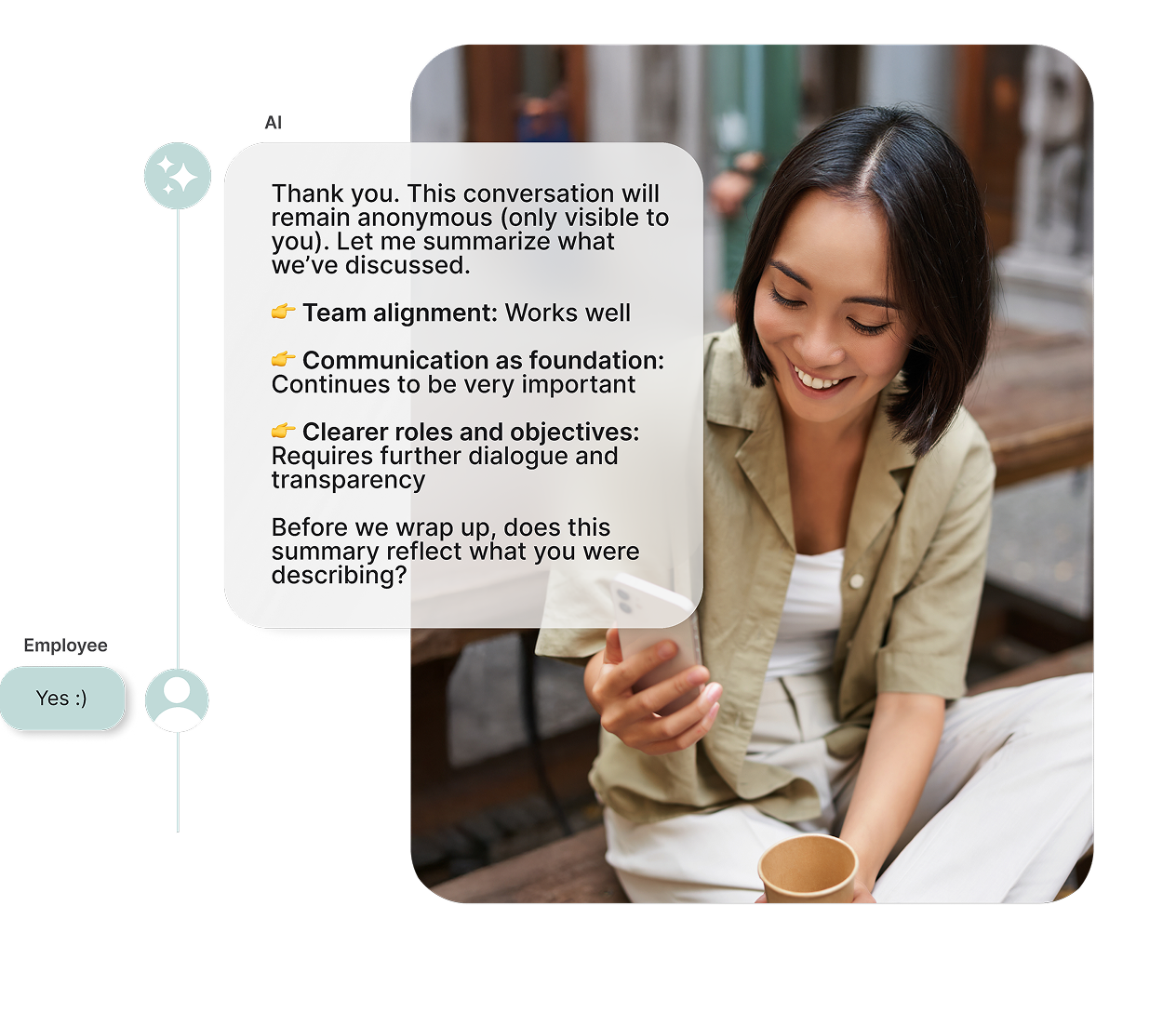
AI can enable new forms of listening altogether. For example, AI-powered conversations allow employees to engage anonymously on specific topics, uncovering deeper context behind survey results.
These systems continuously learn over time, leading to measurable improvements in engagement.
The future of employee listening
Gathering feedback is the easy part. What matters is what happens next.
Every organization is different and next generation listening acknowledges this by building flexibility into the foundation of feedback so every team can listen in the way that works best.
But flexibility without follow-through is just more of the same problems. What next generation listening delivers, above all else, is a way to implement action.
By providing all managers with real-time insights and actionable guidance, organizations can finally close the gap between feedback and decision-making.
Next generation employee listening turns feedback into action at scale, helping organizations move from just collecting opinions to truly improving how people work, lead, and perform together.
Do you want to explore the number one tool for next generation employee listening?
Book a demo
Winningtemp is the employee listening platform built to fit any listening strategy. We deliver high-quality insights and transform them into clear, actionable guidance for every manager. Just empowered leaders and high-performing teams built on employee feedback.
Why is employee listening important?
Employee listening is the process of gathering, analyzing, and acting on employee feedback across an organization.
It allows companies to understand what employees are experiencing in real time, identify emerging challenges, and make informed decisions that improve the employee experience and overall business performance.
However, collecting feedback alone is not enough: action is what’s important. Data from thousands of organizations shows that when employee feedback is consistently acted on, it leads to improvements in engagement like higher trust in leadership, stronger participation, and increased employee initiative.
Why is employee engagement decreasing?
The problem isn’t that employers are listening to their employees: the issue is that they’re not taking action.
Organizations are measuring employee engagement more than ever before. From pulse surveys and engagement platforms to real-time dashboards, there’s more tools than ever and plenty of data in the backlog. Yet engagement rates continue to fall.
Global employee engagement dropped to 21% in 2024 (its lowest level since the pandemic) costing the world economy an estimated $438 billion in lost productivity, according to Gallup.
In the US, only 31% of employees are engaged. And in Europe the situation is more dire, at just 13%.
Many organizations lack the structures needed to translate employee feedback into meaningful action. At the same time, managers are often overwhelmed by data but under-supported in how to respond to it effectively.
This is where next generation employee listening comes into play: shifting the focus from only collecting feedback to enabling consistent, informed action across the organization.
What is the best employee listening strategy?
Next generation employee listening is built on three principles that traditional programs have consistently failed to deliver.
1. The first is flexibility. No two organizations or teams are the same. Factors like cultural differences, listening maturity, and company structure can all shape what good listening looks like.
There is no one-size-fits-all cadence, and next generation listening is a hybrid approach that can be adjusted to meet the unique needs of every part of the business.
2. The second is actionability. Gathering feedback is the easy part, but what matters most is what happens after the data is collected.
Next generation listening provides every manager with high-quality insights alongside tailored guidance on how to implement those findings.
3. The third is benchmarking. Being able to benchmark current data to a larger data set is the key to understanding how well you are actually doing.
This allows organizations to track progress over time, because next generation listening is not just about reacting to the now, but preparing for the future.
Do companies need more employee feedback?
For most organizations, the lack of data is not the problem. The issue is that more than half of employees say their employers do very little or nothing with their feedback.
Only 14% believe their employer actually uses feedback to improve the employee experience, and this gap can erode trust in permanently harmful ways.
When employees don't see change after a listening event, future response rates fall, data quality deteriorates, and the next survey produces even less useful insight.
Why? Because even if companies have a wealth of data, a lack of change shows employees that their honesty doesn't lead anywhere.
Are surveys the best way to collect feedback?
Surveys are still the most reliable way to collect employee feedback. So why is ‘’survey fatigue’’ so widely discussed?
Many companies assume that employees are bored by answering feedback surveys. But the research tells a different story.
Survey fatigue is not a reaction to how often employees are surveyed, but it all depends on whether employees believe that their response will make a difference.
The solution to survey fatigue is not fewer surveys: it is faster, more visible action.
How can HR leaders improve the employee feedback process?
By providing more direct, detailed access to insights to managers, HR leaders can drive action rather than just acting as a distributor of survey data.
Next generation listening means that HR is no longer the primary interpreter and distributor of survey data. Instead, it repositions HR as the architect of the listening strategy itself.
3 Ways to Improve Employee Listening
1. Prioritize flexibility in employee listening
Traditional listening programmes were built around a single moment applied across the whole organization, like an annual engagement survey. But those outdated methods were designed for organizations that just don't exist today.
But today's organizations span multiple cultures, markets, languages, and levels of maturity. What works for one team may be entirely inappropriate for a team at a different stage of its listening journey.
Next generation listening needs to be flexible, because a listening strategy should adapt to your organization, not the other way around.
Advice: Improve your feedback processes by implementing a listening strategy that fits your teams’ specific needs. Some teams need frequent, lightweight pulses. Others need the depth of a structured engagement survey. Many need both.
2. Go beyond the data with tailored guidance.
Most of us aren't experts at interpreting data, which is why it’s important to have a summary of what the data actually means.
Next generation employee listening translates those insights into plain-language direction that helps managers understand what is driving those results and what actions will make a difference.
When every manager has direct access to how their team is doing, the actionability gap closes and the potential for trust grows.
Advice: Rather than just producing reports for HR to interpret and hand off, instead focus on providing high-quality insights directly to all managers so they can begin to strategize and take action.
3. Build a complete view through multi-channel listening.
No single questionnaire can capture the full employee experience, which is why it's crucial to collect feedback through multiple channels.
● Engagement surveys provide depth and benchmarking opportunities.
● Pulse surveys are great for increased frequency and immediacy across teams.
● Qualitative conversations offer deeper context and nuance (the ‘’why’’ behind the numbers).
Next generation listening strategies combine all of these methods producing richer, more actionable insight than any single method could deliver alone.
Advice: To implement a multi-channel approach without overwhelming teams, start by clearly defining the purpose of each channel. Make it explicit why feedback is being collected, how will be used, and how it will lead to visible change.
How can AI improve employee listening?
AI can translate complex employee data into easy-to-understand guidance that allows every manager (regardless of their experience handling data) to understand what their team needs and then take meaningful action.
For many, looking at employee data can feel overwhelming but AI bridges that gap for managers. However it’s important to understand how AI will be used, and how it may affect your employees.
A 2025 study found that 78% of workers distrust AI tools handling personal feedback, fearing surveillance or misinterpretation.
That’s why for AI to be effective, employees must trust it’s working for them, not monitoring them. That's why it’s helpful to understand the ways in which AI can interact with employee feedback.
Can AI do more than summarize data?
The most common application of AI in listening is summarizing data: taking large volumes of responses and surfacing common themes. This is useful, but it doesn't help turn feedback into action.
However, AI can also be used to help provide guidance. By taking a team's data, it can analyze it and produce specific, contextualized recommendations. This sort of AI system can detect patterns across multiple listening cycles and flag it before it becomes a retention risk.
AI also enhances how insights are delivered and used. It can summarize survey data alongside trend development and benchmark comparisons, giving managers and HR a clearer understanding of where they stand and what needs attention.
AI can enable new forms of listening altogether. For example, AI-powered conversations allow employees to engage anonymously on specific topics, uncovering deeper context behind survey results.
These systems continuously learn over time, leading to measurable improvements in engagement.
The future of employee listening
Gathering feedback is the easy part. What matters is what happens next.
Every organization is different and next generation listening acknowledges this by building flexibility into the foundation of feedback so every team can listen in the way that works best.
But flexibility without follow-through is just more of the same problems. What next generation listening delivers, above all else, is a way to implement action.
By providing all managers with real-time insights and actionable guidance, organizations can finally close the gap between feedback and decision-making.
Next generation employee listening turns feedback into action at scale, helping organizations move from just collecting opinions to truly improving how people work, lead, and perform together.
Do you want to explore the number one tool for next generation employee listening?
Book a demo
Winningtemp is the employee listening platform built to fit any listening strategy. We deliver high-quality insights and transform them into clear, actionable guidance for every manager. Just empowered leaders and high-performing teams built on employee feedback.


