
Leadership training or team spirit — where would you put your budget?


Here's a question most HR leaders have never been asked directly: if you had one million dollars to invest in your people — would you spend it on 100 managers or 1,000 employees?
Most organizations, almost automatically, tend to concentrate a disproportionate share of their development budgets on leaders and managers.
And it's not hard to see why. Leadership programs come with a clear owner, a curriculum, and a certificate at the end. They feel like a real investment. Team spirit, by contrast, is harder to legitimize. It lives in how teams collaborate, make decisions together, challenge each other's thinking, and in the atmosphere that makes all of that possible. It's real, but it doesn't come with a price tag that's easy to defend in a budget meeting.
But what if that's exactly the problem? The things that are easiest to defend in a budget meeting aren't always the ones that move the needle most. What if organizations are systematically overinvested in leadership, and underinvested in the teams those leaders are supposed to be building?
It's a debate worth having. Because the case for leadership development is strong. And so is the case for team spirit.
The case for leadership development — and it's a real one
Let's be clear: the argument for investing in leaders is not just intuitive. It's backed by serious evidence.
Gallup's research shows that managers account for roughly 70% of the variance in team engagement across business units. That's a staggering number. It means the single most predictive variable in how engaged your employees are isn't the strategy, the pay, or the perks. It's who their manager is and how well that person leads.
The evidence backs this up. A review of 335 leadership training studies found the returns are larger than most organizations assume. And Gallup's research shows that when leaders communicate openly and explain the why behind decisions, employees are over ten times more likely to trust the direction the organization is heading.
The logic follows cleanly:
- Better leaders create clarity.
- Clarity builds trust.
- Trust enables performance.
Invest in leadership, and everything else improves downstream. It's a compelling argument. So why isn't it the whole answer?
The case for Team Spirit and Participation, and it's equally strong
Here's where the debate gets interesting. McKinsey's research points to something that should make every leadership-first organization pause: a positive team climate is a stronger driver of performance than leader behavior alone. The manager shapes the environment, but it's the environment that actually moves the needle.
And the highest-performing teams aren't the most harmonious. They're the ones with the strongest team spirit: sharing information openly, solving problems creatively, and actively challenging their own thinking. Deloitte's 2024 Human Capital Trends found that 71% of leaders say culture is now built at the team level. Most of what determines whether your people perform, stay, and grow is happening in spaces your leadership programs never reach.
The participation argument is just as strong. When employees have real influence over how the team works — not just a manager who listens, but actual ownership over decisions — team spirit has something to grow from. Without it, you can have the most feedback-heavy culture in the market and still watch people go through the motions.
The logic follows cleanly:
- Better team spirit creates collaboration
- Collaboration builds ownership
- Ownership drives performance
Invest in team spirit, and the returns don't flow through the manager. They flow through the team itself. So which argument wins?
What do high-performing organizations prioritize? Everything, but not equally.
Winningtemp's 2026 research report analyzed data from 876 organizations and more than 236,000 employees. According to the findings, High Performers invest broadly, not in one heroic dimension.
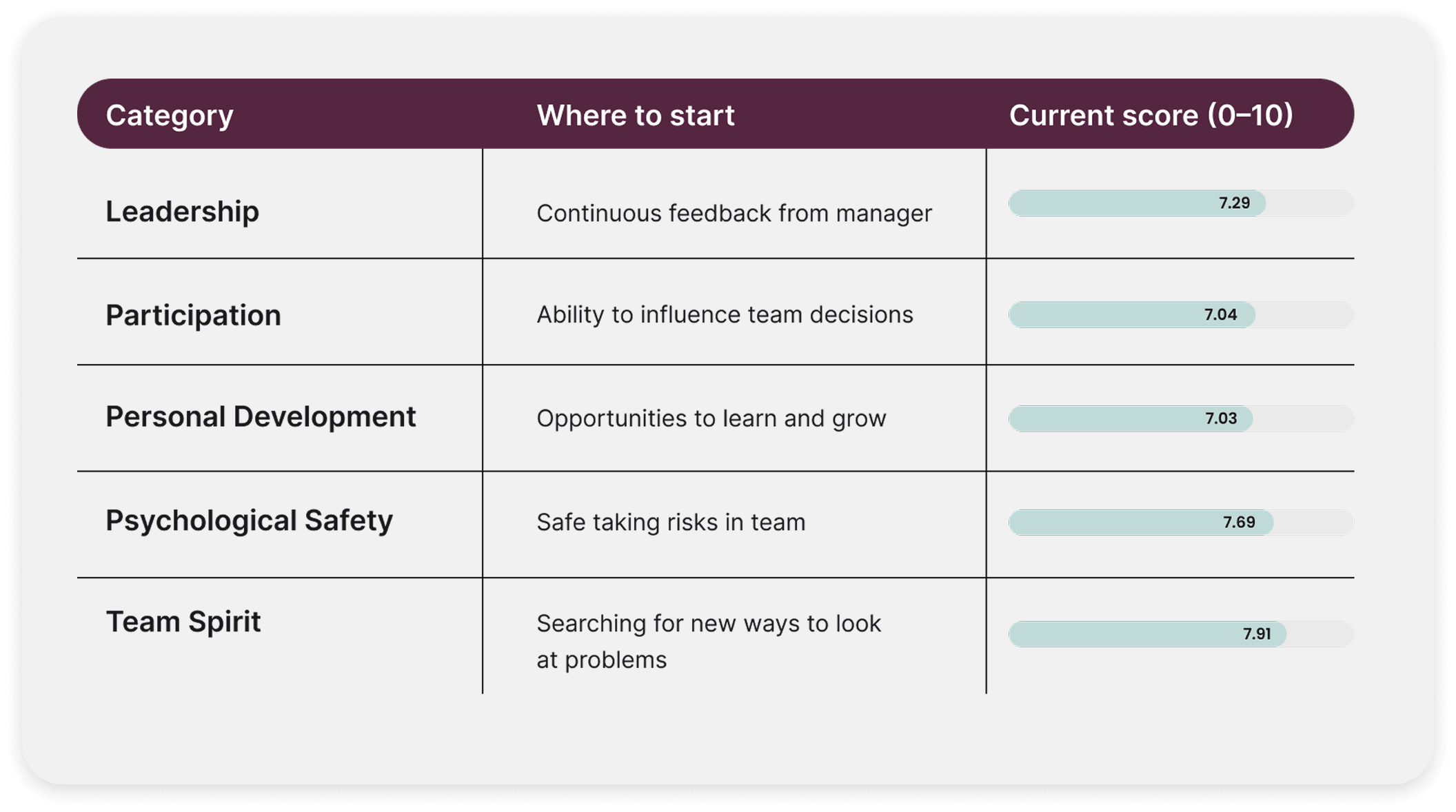
But when looking closer, Team Spirit and Participation emerge as the two strongest independent predictors of high performance, ahead of Leadership, Personal Development, Psychological Safety, and Trust.
The most differentiating question in the entire dataset isn't about manager quality or leadership clarity, it's:
"My colleagues and I search for new ways of looking at problems to achieve the best possible results."
This is a team behavior, not a leadership behavior. Leaders can influence it, for better or worse, but they do not own it. And when it comes to predicting outcomes, it is more powerful than any other single measure.
What other conclusion can we draw from this? Four of the five categories, score below 7.5. None of them are solved by a training program alone. Leadership is on the list, but so are Team Spirit and Participation. The data doesn't pick a side. It asks you to invest in both.
So what should HR leaders actually do?
The answer isn't to stop investing in leadership. The evidence is real and the returns are there. The answer is to stop treating team spirit as the thing you get to once the leadership work is done, because for High Performers, it's not a downstream benefit. It's a parallel investment.
Karin Dahl, CHRO at Winningtemp, puts it well:
"You can have good team spirit with bad leadership. A team can hold itself together despite the person leading it, but not indefinitely. What you almost never see is good leadership with bad team spirit, because a good leader will notice it and start working on it. So if I have to choose, leadership is the one that pulls the other along. Not because leaders own team spirit, the team does, but because a good leader is the one who refuses to ignore it."
It's a position the data supports. But it only holds when leaders are genuinely invested in it, not just trained, but paying attention. The organizations that plateau are often the ones where leadership programs are running and team spirit is quietly declining.
So back to the opening question: 100 managers or 1,000 employees? The easiest budget decision isn't always the right one. If your current investment only reflects one of them — you already know which one to revisit.
Is team spirit on your budget, or just on your agenda?
Want to see how your organization stacks up? Download the full report to see how 876 organizations, 236,000 employees, and seven findings can change how you think about culture.
Share insights




Table of content
Related Blogs

What your engagement data is telling you, and how Winningtemp leads the way

Why psychological safety is failing women — and what HR can do about it

What 236,000 employees reveal about high-performing organizations
Get in touch
Let us help with employee listening


