The Complete Guide to Pulse Surveys 2026
Learn what pulse surveys are, how they differ from annual surveys, which tools are best, and how AI is transforming HR.
Jump to what interests you
Click a heading to jump directly to the section.
What is a pulse survey?
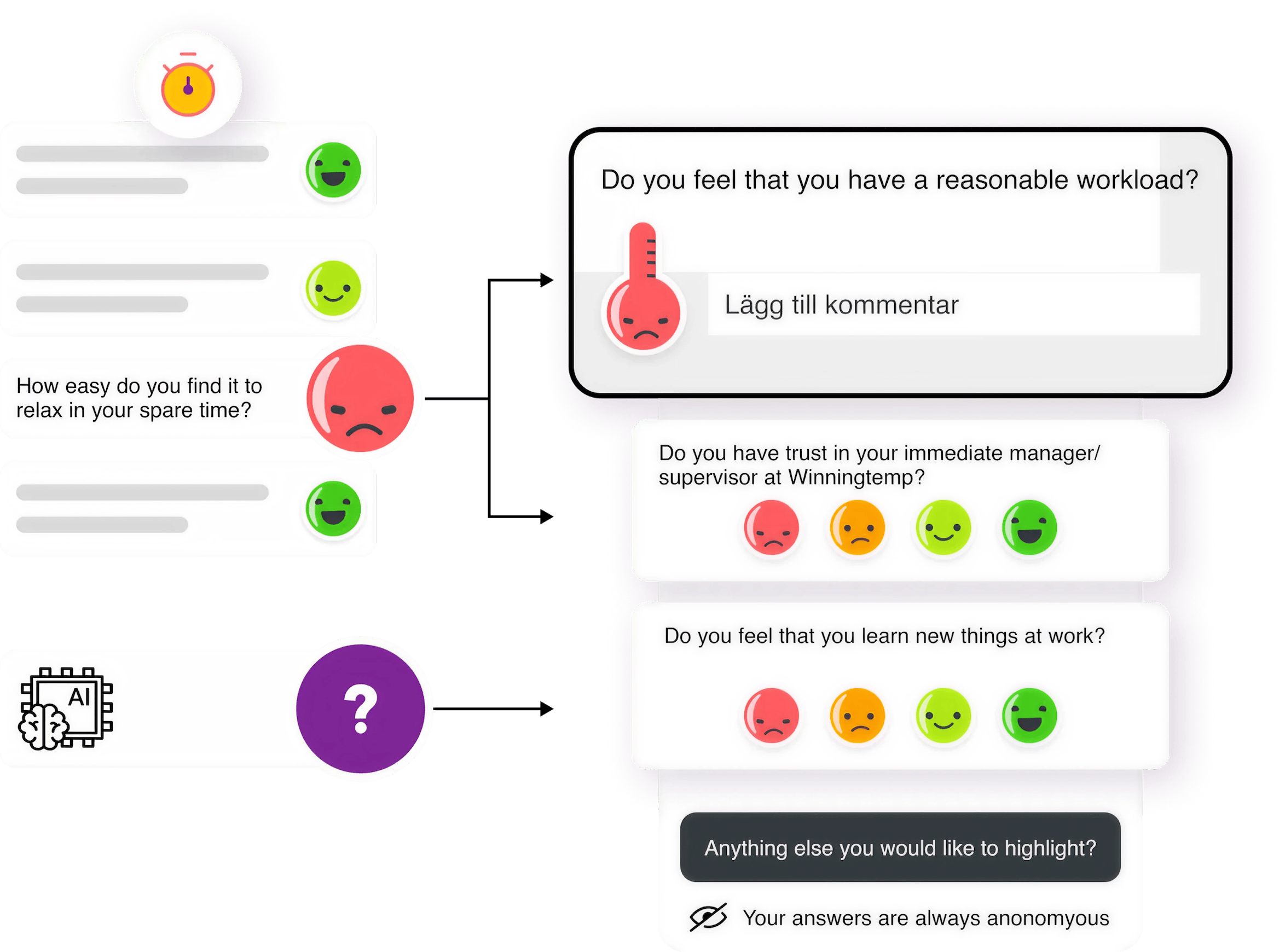
A pulse survey is ashort, regular employee survey with 5–15 questions sent out every two to four weeks.
What is the difference between pulse surveys and traditional employee surveys?
Unlike traditional annual surveys, pulse surveys provide real-time data on engagement, well-being, and work environment.
AI-powered platforms like Winningtemp analyze response data automatically and provide predictive insights based on over 600 scientific studies —managers are warned about declining engagement before it shows in productivity or employee turnover.
Why have pulse surveys become so popular?
This allows leaders to get informationand take action fasterbefore it impacts the company's profitability.
Why should you care about Engagement?
21%
Global engagement 2024 — lowest since the pandemic
70%
Of team engagement depends on the manager's behavior
51%
Lower employee turnover with high engagement
85%
More engaged when leaders communicate transparently
Pulse survey vs. traditional employee survey
The most effective strategy is a hybrid model: short pulse surveys every two to four weeks, complemented by one to two more comprehensive surveys per year.
Feature
Pulse survey
Traditional annual survey
10 reasons to start with pulse surveys
Real-time data
Capture changes week by week, not months after they occurred.
Higher response rate
Mobile-optimized platforms deliver 40–60% higher response rates (HR Cloud).
Early warning
Identify declining engagement and stress risks before they lead to sick leave.
Employees feel heard
Only 23% feel their employer acts on feedback (Gallup, 2024).
Data-driven leadership
Give managers objective data. Managers drive 70% of team engagement.
Reduced employee turnover
Replacing an employee costs 50–200% of annual salary (Gallup).
More efficient resources
Direct efforts where they make the biggest difference instead of spreading them evenly.
Support during change
Track employees' experience before, during, and after reorganizations.
Meet workplace safety requirements
Systematic workplace safety management requires regular follow-up (Swedish Work Environment Authority).
Predictive HR analytics
AI-powered platforms predict risks and provide automatic action recommendations.
7 steps: How to implement pulse surveys
Define purpose and goals
Clarify why you're implementing pulse surveys and connect to concrete KPIs — engagement, turnover, sick leave.
Choose the right tool
Prioritize scientifically validated question sets, anonymity guarantees, and mobile optimization.
Design the question set
5–15 questions per survey. Cover engagement, leadership, workload, team collaboration, and well-being.
Anchor with leadership and organization
Explain why, how, that responses are anonymous, and what happens with the results.
Run a pilot period
Start with 20–50 people over 6–8 weeks. Aim for 70%+ response rate.
Roll out and establish rhythm
Every two to four weeks. Monday or Tuesday morning typically yields the highest response rate.
Analyze, communicate, and act
Managers see results within 24–48 hours. Without visible follow-up, response rates decline.
Average results from Winningtemp customers
After one year with Winningtemp, customers report on average:
-30%
+48%
-26%
The best pulse survey tools 2026
The ranking is based on features, AI capabilities, Nordic presence, and user-friendliness.
1.

Leading AI-powered platform in the Nordics. Built on 600+ scientific studies, with burnout warnings, AI summaries, and EU AI Act-compliant features.
2. Eletive
Swedish People Success platform with 43+ languages and AI analytics.
3. Culture Amp
Globally established with in-depth engagement analytics and industry benchmarking.
4. Netigate
Swedish platform with powerful analytics and strong API integrations.
5. Workday Peakon
Enterprise platform with machine learning and 60+ languages.
6. Brilliant Future
Nordic benchmarking based on millions of responses. Workplace safety compliant.
7. Simployer (formerly &frankly)
Simple and action-oriented. Fast implementation for Swedish SMEs.
8. Leapsome
All-in-one: pulse surveys + performance management + OKR. 38 languages.
ROI on employee engagement
High engagement isn't just an HR issue — it's a business issue with measurable returns.
+23%
Higher profitability with high engagement
-51%
Lower employee turnover
65%
Increased productivity after EX investment
58%
Improved retention after EX investment
Questions about pulse surveys
What is a pulse survey?
A pulse survey is a short, regular employee survey with 5–15 questions sent out every two to four weeks. It provides real-time data on engagement, well-being, and work environment.
How often should you conduct pulse surveys?
Every two to four weeks. Complement with more comprehensive surveys 1–2 times per year. More frequently than every two weeks risks survey fatigue.
Are pulse surveys anonymous?
Yes, in all serious tools. Best practice is a minimum group size of 5 people to show results, which prevents individual responses from being identified.
What distinguishes a pulse survey from a traditional employee survey?
Pulse surveys are short (5–15 questions, under 5 min) and frequent (every two weeks). Traditional annual surveys are long (50–100+ questions) and done 1–2 times per year.
Can AI really improve pulse surveys?
Yes. Winningtemp offers AI translation, AI summaries of open-text responses, individual-level burnout warnings, and AI-generated action suggestions — all EU AI Act compliant.
What does it cost not to measure engagement?
Replacing an employee costs 50–200% of annual salary (Gallup). Globally, declining engagement cost $438 billion in lost productivity in 2024.
Ready to take the pulse of your organization?
See how Winningtemp helps HR teams go from data to action — in under 5 minutes a week.
Sources
Gallup (2024): State of the Global Workplace
Gallup (2025): Global Engagement Drops — $438B in Lost Productivity
SHRM: Building a Connected Workforce
WorkTango & Lighthouse Research (2024): ROI of EX Software
Swedish Work Environment Authority: Systematic Work Environment Management (SAM)
ContactMonkey (2025): Pulse Survey Results


