
From gut feeling to growth: How Fellowmind turned employee data into their biggest competitive advantage

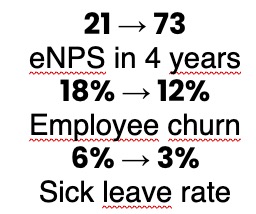
When Kajsa Norell joined Fellowmind Sweden in 2021, the company had just started the integration of 12 companies into 1. The sick leave rate was around 6%, and the eNPS 21. Four years later, sick leave has halved, eNPS sits around 70, and Fellowmind was named Sweden's best employer. Kajsa shared this and munch more in a recent webinar with Rumbold. Read on and learn how they reached those results — and what every HR leader can take from the journey.
Start with why — then get everyone to agreeFellowmind didn't begin by launching a tool.
They began by building a shared belief: that engaged, happy people perform better, stay longer, and walk the extra mile. Getting that conviction into the room — from the CEO and Regional Directors down to every team leader —was step one.With full leadership buy-in from day one, including unwavering support from Regional Directors, Kajsa was able to put people data on the same agenda as financial results. Not as a soft metric. As a KPI.
One KPI to rule them all: eNPS
Fellowmind chose eNPS — employee net promoter score — as their primary engagement metric. It's simple, benchmarkable, and honest. When you ask someone whether they'd recommend their employer, they instinctively weigh everything: the work, the culture, the leadership, the day-to-day reality.
When they started in 2021, team scores ranged from –60 to +92. Today, every team is above zero — and has been since mid-2023. That consistency didn't happen by accident.
Weekly pulse, not annual survey
The most common objection to frequent listening? "It's too much." Fellowmind's answer: six questions a week, AI-selected based on what's most relevant for each team. Responses are anonymous. The process takes employees under two minutes.
They also run one full deep-dive per year — all 70 questions, at the same time across the entire organisation — to get a clear snapshot that isn't coloured by timing or mood. And for high-pressure situations, like a major rollout, Kajsa builds custom pulse surveys to keep a closer eye on stress and team dynamics in real time.
"If you do it bi-weekly and someone misses it, you lose a lot. Weekly means missing one week is fine. The data still holds." — Kajsa Norell
85% participation or the data doesn't count
Kajsa is clear about this threshold: below 85% response rate, the numbers can't be trusted. The people who aren't answering are often the ones with the most to say. Participation is treated with the same seriousness as the results themselves.
Leaders own the data
The people function sets the direction, but every team leader owns their own results. At Fellowmind, leaders are expected to review their Winningtemp data weekly, respond to anonymous comments within a reasonable time, show results to their teams monthly, and initiate action plans when trends start to slide.
Action planning: the team is the solution
When a metric drops, Fellowmind doesn't guess at the cause. They convene the team, zoom in on the specific question or category flagging concern, gather improvement ideas collectively, vote on one to three priority actions — and start the next day. Then they follow up, weekly if needed.
The rule that changes everything
"Don't ask unless you're prepared to change. Nothing kills motivation faster than asking for feedback — and then ignoring it." — Kajsa Norell
This is Fellowmind's non-negotiable. Acting visibly on feedback is what builds trust. And trust is what keeps people answering honestly, week after week, instead of gaming the system or tuning out entirely.
True scores beat high scores
Fellowmind doesn't optimise for impressive numbers. They optimise for accurate ones. A 73 eNPS that reflects reality is worth infinitely more than a 90 built on wishful thinking — because the 73 tells you exactly where to go next.
- Get your leaders convinced first. When they believe in it, it becomes real for everyone else.
- Set a participation threshold and treat it like a KPI. Data you can't trust is worse than no data.
- Weekly pulsing with fewer questions outperforms annual surveys with many.
- Make action planning a team exercise, not an HR exercise. Ownership drives change.
- Communicate back. Every improvement initiative should be visibly tied to what people said.
- Celebrate honestly — but aim for truth over flattery in your scores.
Share insights




Table of content
Related Blogs

What your engagement data is telling you, and how Winningtemp leads the way

Leadership training or team spirit — where would you put your budget?
Why psychological safety is failing women — and what HR can do about it
Get in touch
Let us help with employee listening


