
What is eNPS and how do you use it the right way?

.png)
eNPS, or Employee Net Promoter Score, has long been a popular go-to metric for HR and leadership. It’s quick to measure, easy to communicate, and gives a snapshot of how employees perceive their workplace.
But beyond being a pulse on employee sentiment, eNPS has serious business implications.
When used right, it can reveal early warning signs of disengagement, signal strengths in culture and leadership, and help you track how internal trust and loyalty evolve over time — all of which directly impact retention, productivity, and company performance.
So what eNPS actually is, how is eNPS measured, and what role does it play as a strategic tool? In this article, we break down how it works, how eNPS is calculated, why it’s more than just a number, and how to use it as a lever for long-term business success.
What does eNPS mean, and what is eNPS in practice?
eNPS stands for Employee Net Promoter Score and is based on the same principle as traditional NPS — asking employees how likely they are to recommend their workplace to others, typically phrased as: "How likely are you to recommend working at [company name] to a friend or an acquaintance?"
Here’s how eNPS is measured in practice:
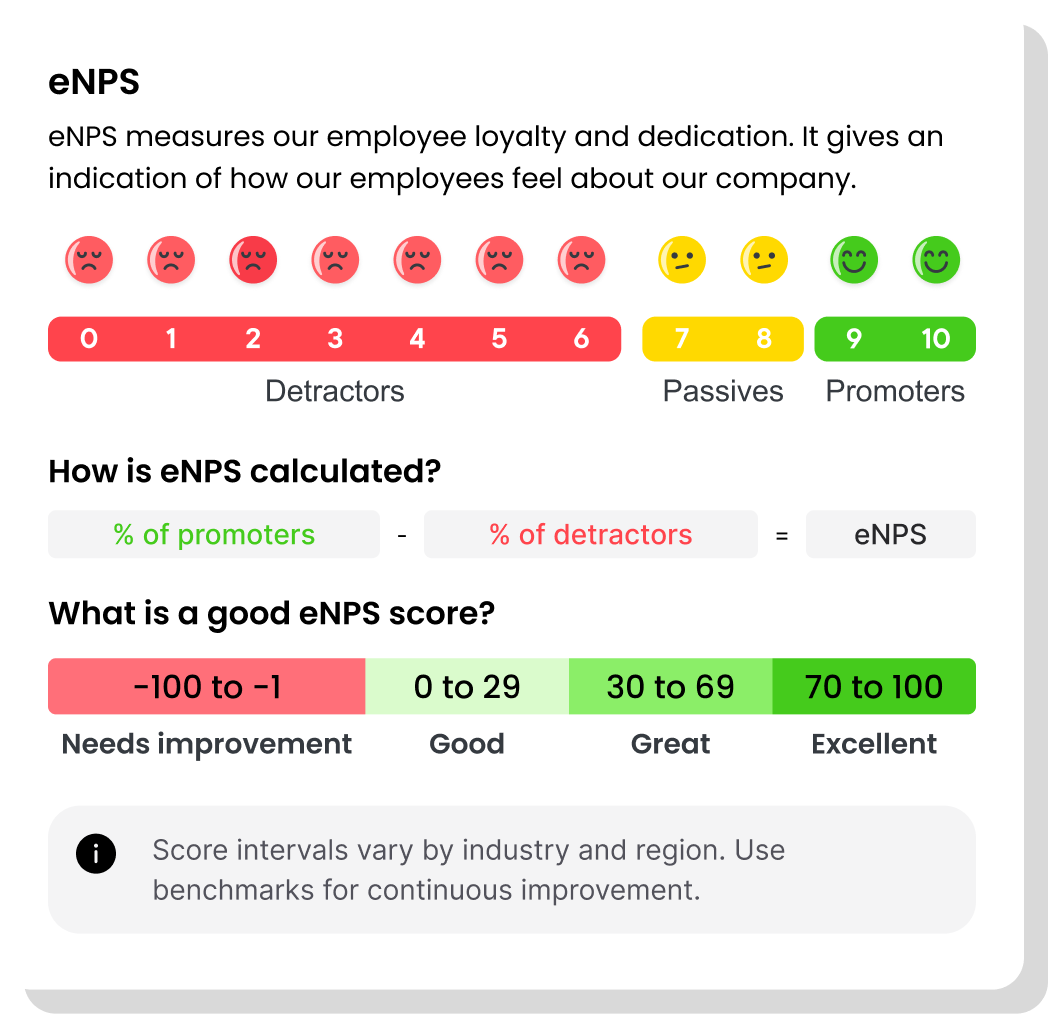
- Promoters (9–10) – Engaged employees who are loyal and likely to recommend their employer.
- Passives (7–8) – Neutral, not unhappy, but not particularly enthusiastic either.
- Detractors (0–6) – Disengaged employees who are dissatisfied and may impact team morale.
How is eNPS calculated?
To calculate eNPS, you subtract the percentage of Detractors from the percentage of Promoters:
eNPS = % Promoters – % Detractors
The result can range from –100 to +100.
What’s a good eNPS score?
It depends on what a good eNPS actually is.
There’s no universal “good” eNPS benchmark. What counts as high or low varies across industries, countries, and company types. Some sources mention an average around +21. Others place it closer to +14–15.
In our own analysis of over 1,300 organizations using Winningtemp (2024–2025), we saw significant differences between industries:
- +42 in hospitality
- +40 in retail/sales
- +36 in finance
- +31 in tech
- +14 in public sector
- +9 in manufacturing
What does this mean for you?
Benchmarking gives you helpful context, but it’s not the full picture. Knowing your industry average is a useful starting point, but the goal should always be to improve your own results over time. An upward-trending eNPS is a sign you’re on the right track, no matter where you start.
What affects eNPS, and how can you improve it?
At its core, eNPS measures employee loyalty. But it reflects much more: a sense of belonging, trust, meaning, and personal growth.
When we analyzed data from over 1,000 organizations, four factors stood out as being strongly correlated with higher eNPS:
- Job satisfaction - Employees who enjoy their day-to-day work are more likely to stay and recommend their company.
- Participation – When people feel involved and listened to, their loyalty and engagement increase.
- Meaningfulness – Understanding how their work matters makes employees more motivated and committed.
- Leadership – Trust in direct managers had the highest correlation with eNPS.
→ Want to explore these drivers in more detail? Download our full report here.
How to use eNPS the right way
eNPS is a great signal, but it’s not the whole story. To turn it into something truly useful, you need to put the number in context and connect it to deeper insights.
We asked our CHRO, Karin Dahl, to share how she works with eNPS in practice. Here are her top three tips:
1. Start with your why
“If you don’t know why you’re measuring eNPS, it easily becomes something you do just because you’re supposed to. For us, the goal is to understand engagement and create a better work environment. That’s the foundation that guides everything else.”
→ Before you measure: What are you trying to understand, change, or improve?
2. Track trends over time
“One number won’t tell you much. What matters is how it changes over time. That’s why we use pulse surveys — they help us see shifts early and act fast when something stands out.”
→ Don’t just react: measure frequently to catch trends before they grow.
3. Put the score in context
“eNPS is a single question with a numeric answer — and that’s its biggest weakness. It lacks nuance. We always combine it with other temperature questions in our pulse surveys to get a fuller picture. We also run focus surveys in Winningtemp to dive deeper and understand what’s really behind the score. That gives us actionable insight to improve engagement.”
→ Use eNPS as a starting point, but dig deeper to understand what’s driving it.
4. Follow up and close the loop
“This part is critical. People need to feel that their feedback leads to something. We always communicate the results clearly; what we’ve seen and what we’re doing next. Otherwise, you risk creating a feedback black hole that erodes trust.”
→ Show employees their voice matters, or risk losing their trust.
When eNPS becomes meaningful
Used the right way, eNPS can be a powerful early indicator of culture, risk, and momentum. It helps you understand how engaged, loyal, and vocal your employees are, and it signals when something might be off.
But eNPS is also sensitive to major organizational events such as layoffs, leadership changes, and restructuring, often dropping sharply after poorly handled changes. That’s why it’s crucial to go deeper.
At the same time, eNPS is also sensitive to major organizational events like layoffs, leadership changes, or reorganizations, especially when handled poorly. That’s why it’s crucial not to stop at the number.
The real value comes when you follow up. Ask: Why does the score look like this? What’s behind the shift?
That’s when eNPS stops being just a number and becomes a real tool for change.
And remember: The biggest risk with eNPS isn’t getting a low score: it’s collecting feedback and doing nothing with it. Because when employees take the time to share, they expect to be heard.
Want to go deeper?
Our latest report is based on over 10 years of feedback data from 1,300+ organizations — and includes the top engagement drivers, clear industry benchmarks, and practical strategies for improving eNPS.
Share insights




Table of content
Related Blogs
.png)


Get in touch
Let us help with employee listening


